Bearded Dragon Fact Sheet for Kids
Home Page

Bearded Dragon Care Sheet

Photos I

Photos II

Guest Book Page

Photos III

Photos - A shedding snake

Rheumatoid Disease/ Feltys Syndrome


Your own small Dinosaur

I believe that only education will correct the addage  'The best snake is a dead snake" - - Educate the children and they will become interested and find the fascinating world of reptiles for themselves.

Australian children should be made totally aware of the reptiles in their region, the perils and the unfounded fears.

Keeping reptiles is a surefire way of expanding horizons and gaining lifelong knowledge about a greatly misunderstood Native animal.

From turning over rocks as a child and finding skinks to keeping your own reptile, is a fascinating journey. And suitable for all age groups

We live - We learn.

Learning about one species will open the doors to much more information about your local wildlife.


Please read on:- 

Care and Fact Sheet

    An Aussie Kids First Bearded Dragon
*with an Introduction to the Parent/Caregiver of the Budding Herpetologist

    I'm going to tell you why a Bearded Dragon is a good Australian Reptile to keep as your own first Reptile. 

    But, before we talk about the fun side. Let me just tell you the main rule, the bottom-line of owning, keeping and raising your Beardie.

First and Foremost - research the Reptile you want to keep next, apply for your Reptile Keepers Permit Class1 from National Parks & Wildlife Service. (It's possible to download an application from the NPWS website). This will take approximately 4-6 weeks to be in force after you have sent your application form and fee. Take this time to continue researching and constructing a habitat for your new pet.

    Give this a minutes thought - these will be your responsibilities.
it will NEED heat
it will NEED light
it will NEED food
it will NEED water

 it will NEED contact with you  - and once they are in the tank they cannot escape to find their own needs -  you are who they depend on.

Here are some questions for you to ask yourself:

       Do you really care about animals?

       Have you got at least a half hour everyday to feed your lizard and have contact with it?  if no, don't get one. if yes.  good. You will need that much time at least to prepare the food and to watch him eat and play!

       Have you time to clean a cage of droppings and excess food daily?

       Are you  someone who will read books and check sites, get books from the library and ask others who know more than you do, any question that you dont  know the answer to?  If yes, good.

       If no. You may like a pet rock.

       Do you lose interest easily in pets?  if no, this is good,  this will be a great experience. if yes, then dont get a Bearded Dragon. They have long life spans  and cannot be released into the wild if you get tired of them (you won't get tired of them)

      Have you got chores to do that will allow you to buy crickets and extra suppiles, plus maybe even pay Veterinarian bills?  if yes, good.  if no, discuss this with your parents/guardian.

      Did you know all  wild Australian reptiles are protected and any form of cruelty or mistreatment is to be reported as it is an offense by law? If no, well now you know.  There are very hefty fines for neglect of your captive animal also.

Getting to know them


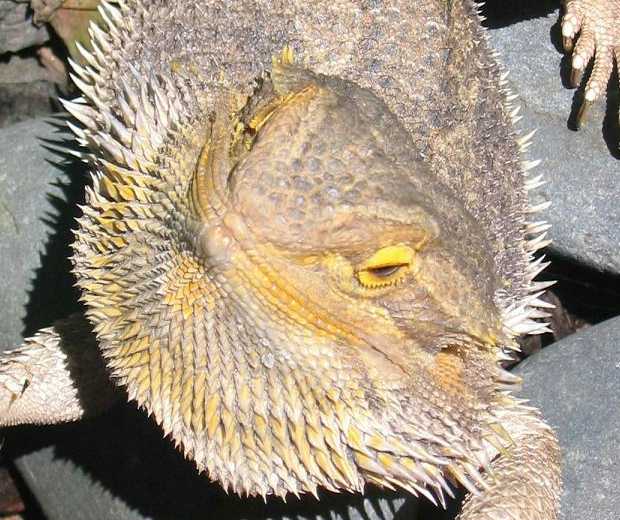
        One of the nice thing about beardeds is that they dont seem to mind you being there really..they will show you that they own their tank. He will turn very black underneath his chin and flare out his beard and spikes, flatten and puff out his belly, he will sometimes open his huge orange mouth and hiss. He is using instinctive behaviour to make himself look bigger and more frightening.  

       Do not be dismayed if your dragon 'displays'. its a natural territorial - mating - defense. It's not a sign of anger or aggression. He's not cranky really I promise you, he is usually showing you that you have come too close when he wasn't expecting you or you've put your hand in his territory. Just leave him alone for a bit. Sometimes i leave mine to display for a little while, because its natural,  You will get to know your own dragon and find out he can be picked up at any time.

       I personally believe if your bearded dragon isnt displaying once in a while,  he's not a happy Dragon.  Check his tank temperatures and diet.


Set up his territory

       They dont like to be moved around from tank to tank.  set up a good sized tank (thats another one of the fun parts) that will last them a lifetime.  REMEMBER that can be a long time.   They will claim favourite places to bask and to cool down, they will bob heads, run about, wave arms, bask like a bump on a log for hours, lick - (not really licking more like investigating with their sensitive tongue) everything in sight. They will respond to their own reflection in the glass and wave their arms at themselves.

       When you first get your new Bearded try to allow it to adjust to its new surroundings. Pick it up as little as possible in the first week. He will become used to his new home in this time and be much happier.

Set Up tips

     All of these products can be found at your local petshop or specialist reptile supply stores.
 
  You will need.

                   a secure, escapeproof  55-75 gallon tank. Glass only.

                   The new tank must be cleaned before you begin your setting up. Wipe it down, both inside and out, with a 2/10 part vinegar solution.

                   UV lighting tube on a timer for at least 8 hours a day.   Natural light is necessary to protect them from vitamin D deficiencies -  but never place a tank next to a sunny window. That's like putting them under a magnifying glass!

                   Water bowls should be big enough for your Dragon to get into and soak...  have it made of something heavy, because they can be rough and tip them over. They will need clean water daily.

                   Heat.  Make sure that he has a 'cool end' with plants, water bowl, and hollow logs and a "basking end"  at 35°C  with his heat lamp rocks and high branches. Two thermometres set in the tank is a good idea.

                   Substrata, or groundbase - bark, clean salt free sand, recycled paper litter, newspaper, rocks or mulch.    place this over the base of the tank up to 6 cms deep.

                   Furniture:  Rocks, hollow logs, branches, plants - either artificial or certain types of live plants. Artificial are best for starters. They like these to hide and camouflage.
                   Branches and rocks that you find outside can be treated before you place them in the tank,  with a bleach spray and lots and lots of rinsing and drying in the sun. Involve Mum or Dad in the bleaching.  1 part bleach to 10 parts water.  You will only need to bleach once, after that,  when you are cleaning the tank; hose the logs etc., down with tap water and leave in the sun to dry.

                   Build your own caves and cool spots from rocks and branches. of course, make sure theyre very safe and won't move if theyre stepped upon by little feet!
                  
                   Some extra ornaments for the budding home decorator - I have  treated and washed shells, a small roman earthenware column, earthenware angel heads that serves as a ledge for basking, large polished pebbles near the water bowl, a very large glass jar with pebbles in the bottom makes a nice warm spot, a small hollow piece of old pottery makes a nice cool spot. 

NOTE:  make sure nothing is painted with a toxic paint, (Dragons will lick it out of curiosity) no sharp or dangerous edges, nothing that could trap the animal.


Feeding preferences. 

                      They can be fed insects such as mealworms, crickets, grasshoppers and beetles. Make sure that no poisons, herbicides or fertilisers have been used if you forage insects from the wild.  Live food is best as it encourages their hunting instinct.  Provide a varied diet of insects and vegetables at any one feed. We occasionally offer other food like good quality minced meat and very occasionally; pinky mice.

For an adult Beardie -  feed once every 2-3 days; for one under 6 months feed daily. Soft mealworms, worms, moths, slaters, woodies. Supplement with bearded dragon pellets and coat the food with Insectivore and calcium powder 3 times a week.

Give them veges : red lettuce, peas, squash, celery, carrot, dandelion greens and flowers, alfalfa, milk thistle, clover leaves, chickweed and flowers.

If you put the small and soft mealies in the veggies the beardies will get the taste of the veggies while going for the mealies.
They like fruit - grapes, strawberries, apple, banana. 

Remember, your Beardie will slow his eating pattern during the colder months. Don't be worried if he is not eating unless he seems unwell.

 
How to handle your Dragon


NB: Always wash your hands before and after handling your Beardie for his healths sake as well as yours.
       
       After they have gotten used to you and the surroundings they are happy to be picked up.

       To pick him up - place one hand under the belly and turn it to support the front and back legs by holding it lengthways. Place your other hand on top of the dragon. they like to sit on shoulders and hang on clothing. You will see why they are called 'velcro lizards' when you pry it from your tshirt.

    Never pick him up by the tail!   If you do youll need to know what to do when you get bitten.  do not for one minute think your bearded 'loves' you too much to bite or to let go when he does bite   ... even if you ask him nicely.  its all by instinct, they don't think the way we do..they are defensive and protective of themselves and their homes.  Not aggresive. 

   What you must know is that large dragons can give quite a painful bite. If and when you are bitten.  -  unfortunately usually its mishandling that will cause a bite.   The more you let the creature dangle from the bite site..the longer and tighter he will hold on  - he doesn't want to fall and he feels very insecure.  just calmly stop trying to shake the lizard off and place his front claws firmly on the ground. He will let go.


   Mating and Territory Marking

When you see your Dragon waving his arms as described above, it's very hard not to wave back. If you have two dragons of mating age, they will head bob and wave and catch each others attention. Sometimes it can look like they're fighting because the male will bite the girl on the back of the neck. Never worry about that. Just ask Mum and Dad to help you buy your first incubator.

    You can keep your Bearded Dragons from mating by adjusting the temperatures and UV light times in their tank.

 Feeding  -     some will watch you from their tank and sometimes even notice when you have food for them so that they will run towards you. Some do that when they see the bright yellow dandelions.
       i have a male that attacks the dandelion greens and flowers as if theyre alive...he thrashes them around before devouring them.   another male will feed better if i allow him  (in a large glass jar) to stalk his prey for a bit first.   some won't eat if I'm watching, or only eat slowly with one eye on me. all are different.

Batheing and Soaking  -     some love a bath...some dont.  once again they are all different about water.
    One will lay completely underwater with his nostirls exposed to air, one will float like a small crocodile with his legs out, one sinks to the bottom and stays there for long time, one 'dog paddles' frantically until he finds his rock island, some dive and swim some just want to get out of there!   the  beardeds that dont like the water ...  i mist.

Drinking methods  -   spray inside tanks on plants and rocks and directly on the Dragons to form droplets which they will lick at.  Begin misting them when they are young or new to you - this will teach them to lick at  the droplets. I have seen mine laying 'flat out like a lizard drinking' sucking down water from a bowl.  and when I give them light sprays in their outside enclosure, one will take a humped over posture and drink as the water drips down, one will do the same posture and allow a puddle to form in front of him.

Waste  -   Once again they have different ways of  disposing of their waste.   you will find that its like a black longish pellet with a white line.  the white line is no.1s (urine) and the black is no.2s..(faeces) see?  some dragons choose a place and use it habitually, some like to use their water bowls and some poop without care...! no manners!.  you cannot teach them but theyre easy to clean up after..
 
Find a good local Reptile Vet.   -  if there is not one closely available, within easy driving distance, find the phone number of the nearest reptile vet and give it to your local vet. for emergencies.  Captive Beardeds will sometimes need vetrinarian help, but in 7 years I have taken one only to a local vet. 
       You will know your Beardeds activities enough to know when it isn't well.

Outside enclosures   -   build one. It's a great fun project.  your Bearded will benefit from a few hours a day in the direct light. a good rule is at least 8 hours a week reguardless of  whether it's overcast or not.
   
Worming  -  See a Vet or ask the breeder you brought your reptile from what he has used and is a proven product.

Sloughing   -   A Bearded will shed its skin as it grows. so if you see that it is not coming away easily, move his water bowl to the basking end of the tank. this will give them humidity that will help them to shed.  Misting with a light spray or letting them soak will also help.  give him a little shower.  Never help them shed this will damage any new scales.
      
             This is just a beginning to many years of enjoyable learning, and a creature that will give you, your family and friends hours of delight, while teaching you about one of our wonderful native species of reptile.

*Parents and the Bearded Dragon

   Your child's first Australian reptilian pet.
    
    We live in a country where it is second nature to check the inside of your shoes if left out overnight. to be aware of movement in the bushes, to wear protective clothing while working out in the garden or field.  We know that snakes can turn up anywhere!!

    Most australians have been raised amongst these deadly creatures and this has given some a healthy perspective on fear. such as 'dont worry till you actually get bit!'
        
    Explain elapid (Venomous)  bites and the need for caution and no fear.
and the basic - simple reason for their existence...and their protection  ie. the fact that they keep the rodent population down and that the red belly black snake will kill a baby brown, in turn keeping the brown snakes from overpopulating etc.,
   When your child takes interest in reptilian behaviour, extends their perception of native animals..both deadly and otherwise.

    It springs to mind when I think of a child owning a reptile...as opposed to a dog or cat or run of the mill 'pet'.  That this experience will breed and nurture discipline, knowledge and respect for what many still see as the unknown.
 
    Your whole family will discover that these medium sized lizards are not to be feared.  That they show a defensive, not aggressive temperament. That they are easily handled, very comfortably adapt to human company, are quite inquisitive  and display interesting mating and territorial behaviour.

    Here is your opportunity to discover and share this realm with your children. You will be surprised at these creatures fascinating idiosyncrasies.   And in the process your child will learn and be educated in an area that is our Australian heritage.

   * Your child must have a permit from NPWS. which is a simple task. You will find the costs and all you need to know by calling them or checking their website.
   * Any animal will bite.  But beardeds will only bite if provoked. Choose a Beardie with a nature that will suit your family.
   *  Buy your child books on keeping Beardeds, books can be underrated with the internet here for information, but a good informative book is invaluable. Begin this long term relationship with one of our many incredible reptile species.


EmN.(c)2004.

Enjoy


Ask me -----I don't promise anything - but I can direct you to 'those who know'
My email


Don't sweat the petty things and NEVER pet the sweaty things